
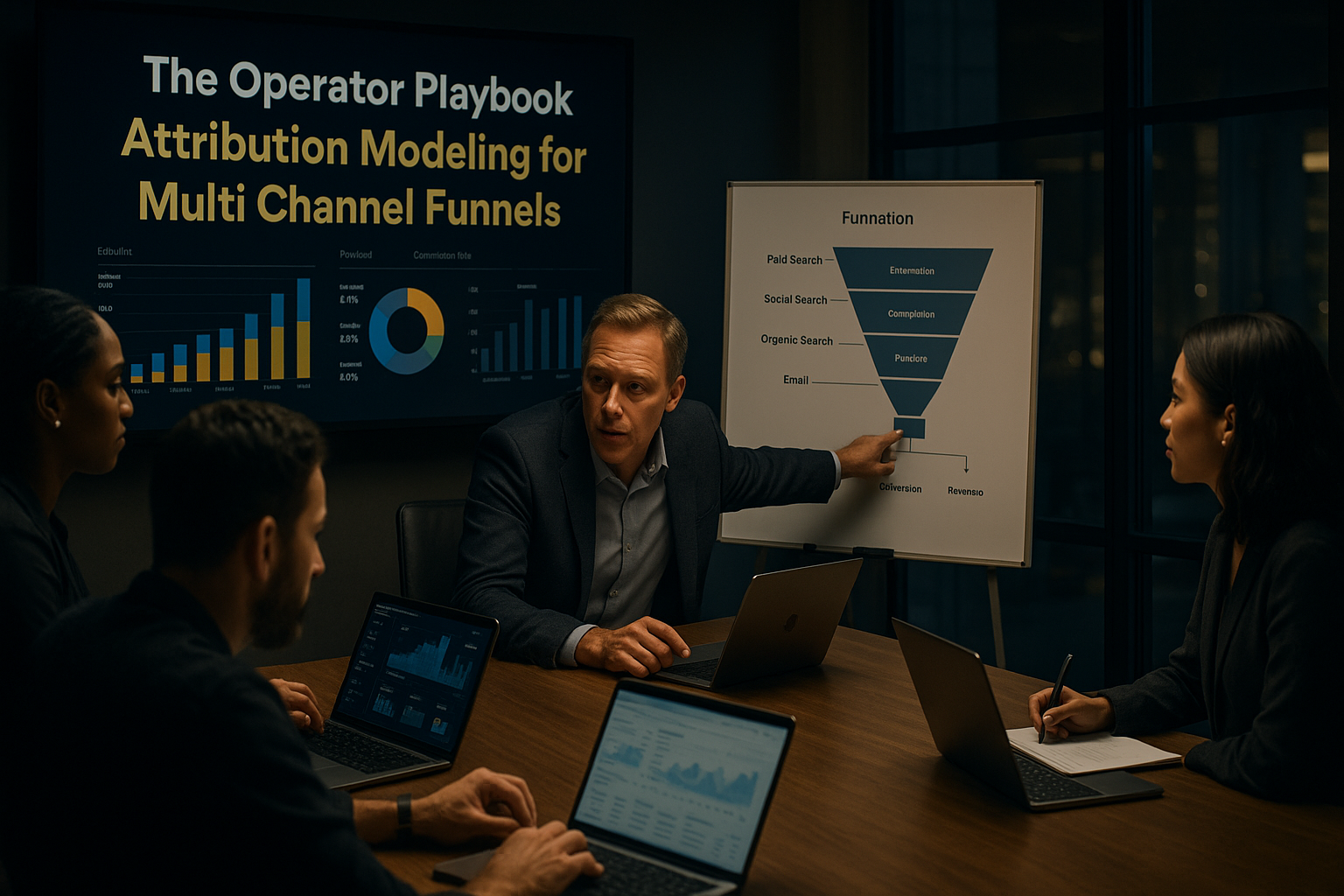
Have you ever wondered why, despite robust investment in multi-channel marketing, the actual business impact of each touchpoint remains so elusive? The Operator Playbook Attribution Modeling for Multi Channel Funnels confronts a problem that’s both familiar and maddening: attribution pitfalls quietly erode growth and blur strategic clarity. As scaled organizations face mounting complexity in 2025, accurate measurement and advanced modeling move from operational hygiene to competitive necessity. It’s not enough to collect more data; operators must rigorously dissect which levers drive performance and where analytics blur the line between insight and illusion. According to search data, 40% of marketers cite inconsistency in attribution methods as a direct roadblock to scaling marketing impact across channels (thinkwithgoogle.com). The Operator Playbook exists because this gap between ambition and execution is growing, not shrinking.
The relevance for scaled businesses is clear. As organizations broaden their channel mix—layering paid social with programmatic display, influencer activation with CRM-driven remarketing—the limitations of conventional attribution reveal themselves at high velocity. Relying on outdated models can result in under-allocating budget to high-impact channels, misreading the contribution of supporting tactics, and ultimately, throttling top-line growth. A recent analysis showed that advanced attribution can increase ROI on digital spend by up to 20%, simply by reallocating resources to channels previously underestimated (cmo.com). For executive teams, being able to trust attribution outputs is not about reporting accuracy—it enables adaptive strategy, defensible investment, and resilient scale.
This Operator Playbook will dissect every layer of attribution modeling for multi channel funnels. In the opening section, we’ll introduce an actionable, internal framework for operators who want attribution analytics that survive board scrutiny and support real-time decisions. Building on that, we’ll surface secondary implications by mapping common attribution pitfalls—revealing why even teams with strong data foundations find themselves in blind spots, and how to resolve these quickly. Section three unlocks unique tips and operator-level best practices, delivering actionable techniques to sidestep dead-ends and maximize analytic sharpness. A dedicated data deep-dive in section four reveals new hypothetical scenarios and statistical insights that challenge conventional wisdom, pushing advanced teams beyond today’s status quo. Finally, section five presents a practical next-step and advanced strategy playbook for 2025, equipping decision-makers and founders to institutionalize attribution as a core asset for the year ahead.
In an era where every growth lever is scrutinized and every dollar must prove its worth, understanding and deploying attribution modeling is far more than an analytics function—it is the underpinning of adaptive, high-velocity marketing strategy. The sections that follow will translate complexity into competitive edge, using referenced industry benchmarks and real operator frameworks to anchor every recommendation. Get ready to see how the right attribution approach restructures not only your marketing analytics but your entire growth trajectory.
The Operator Playbook: Deploying Advanced Attribution Modeling Across Multi Channel Funnels
For operators of scaled enterprises, attribution modeling isn’t a theoretical pursuit—it’s a mission-critical component of campaign management, resource allocation, and executive reporting. The Operator Playbook Attribution Modeling for Multi Channel Funnels is explicitly designed as an internal system, blending process rigor and adaptability to keep analytics genuinely actionable in dynamic markets. This operator-level approach reframes attribution as a living system, enabling ongoing refinement based on channel evolution, data granularity, and shifting KPIs.
First, establish the team structure for attribution governance. In most organizations exceeding $10M in revenue, attribution becomes a cross-functional task: marketing analytics, digital acquisition, finance, and even product routinely intersect. The operator playbook begins with a quarterly attribution council—marketers, data engineers, and operations leaders—reviewing modeling assumptions, data pipes, and error sources. This group codifies rules for new channel launches, consolidates learnings, and aligns on migration paths as the martech stack matures.
Second, assess system architecture. As volume scales, fragmentation grows: web analytics, CRM, social, and offline touchpoints each demand integration. A robust multi-channel attribution setup requires data unification pipelines—typically via CDPs and data lakes—and common identity management. A frequent point of failure is underestimating the lag and loss in mapping anonymous digital footprints to persistent customer records (thinkwithgoogle.com). Experienced operators compensate for this by deploying cross-device IDs, investing in deterministic matching wherever possible, and running regular attribution audits to catch discrepancies.
Third, define which advanced attribution models to prioritize. Linear and last-click models no longer suffice; sophisticated teams pilot data-driven modeling (using Markov chains or Shapley value attribution), U-shaped/hybrid models for journey-specific insight, and AI-enhanced approaches in segments with high-touch journeys. Importantly, model selection is not static. The Operator Playbook demands regular model calibration—comparing projected versus realized business outcomes by channel, and adjusting weights and lookback windows accordingly.
Fourth, formalize analytic cadence. Attribution data must align with executive decision cycles. Weekly dashboards track channel contributions, while deep-dive monthly reviews surface attribution drift—when channel impact diverges from expectations due to algorithm changes, tracking breakages, or demand shifts. Key here is the use of scenario planning: simulate budget reallocations based on updated attribution to stress-test the system before committing real dollars.
A fifth and often-overlooked element is operator communication. Attribution outputs must be translated into non-technical narratives enabling C-suite and board-level buy-in. Too often, mismatches between analytics sophistication and executive understanding result in missed opportunities or delayed pivots. Structured attribution briefings—short, digestible, and grounded in business cases—are core to this playbook.
It’s critical to recognize the upstream and downstream impact of these practices. According to research, 60% of operators identified data silos and poor cross-team handoffs as major inhibitors to actionable attribution (adroll.com). Closing these gaps is an ongoing operational imperative. Additionally, as privacy regulations tighten in 2025, the playbook incorporates proactive consent frameworks and server-side data collection—reducing exposure to attribution decay due to third-party cookie losses or browser-level restrictions.
In summary, the Operator Playbook Attribution Modeling for Multi Channel Funnels is not a static document but a living set of SOPs, accountability rituals, data validation logic, and internal comms guidelines. Enterprise operators who treat attribution as a tactical discipline—updated in cadence with both market and internal change—outpace those who fixate on one-off audits or static reports. This transformation turns attribution modeling into a foundation for adaptive growth, with every operational layer working in concert toward analytic clarity and business acceleration.
Root Causes of Attribution Gaps in Scaled Multi Channel Funnels
Attribution inefficiencies rarely stem from data volume—they originate from architectural and process misalignments that compound as organizations grow. As teams multiply touchpoints, minor inconsistencies in tag management, channel definitions, or handoff protocols snowball into major blind spots within months, not years. Legacy platforms exacerbate this by siloing data—CRM and web analytics systems often track candidates with differing identifiers, making journey stitching a manual and error-prone exercise.
- Fragmented Identity Resolution — As companies add new acquisition channels, persistent user identification becomes taxing. If anonymous clicks on paid channels are never linked to CRM records, attribution models are skewed toward last-touch events (thinkwithgoogle.com).
- Static Model Reliance — Many scaled enterprises persist with outdated models (last touch, first touch, evenly weighted), ignoring that dynamic journeys deserve dynamic modeling. As a result, marketing investments reinforce old channel biases, masking emerging growth levers (adroll.com).
- Data Integration Lag — Synchronization delays between ad platforms, site analytics, and backend customer systems mean attribution windows rarely reflect true customer cycles. In high-volume environments, these lags create resource misallocation and executive frustration when results don’t align with spend.
- Lack of Attribution Ownership — When nobody is explicitly accountable for attribution integrity, critical errors—like duplicate conversion events or misclassified touchpoints—go unnoticed during scale, diminishing C-level trust in reported outcomes.
A new study found that 70% of marketers believe attribution model misalignment directly contributes to wasted marketing spend annually (cmo.com). The business impact is amplified at scale; what appears as minor friction in a $1M system manifests as millions in lost opportunity above $25M in spend.
Operators seeking reliable attribution models must lean into continuous error detection, automated data stitching, and clear executive ownership. By attacking these root causes, marketing analytics quickly evolve from mere reporting to real-time levers for growth. Smart teams combine dedicated attribution councils with centralized data engineering roles and budget for quarterly model refreshes—making attribution integrity a live performance metric. For those seeking to transform this challenge into a growth advantage, partners like gentechmarketing.com bring the cross-functional rigor needed to align multi-channel analytics, data, and leadership under one operational roof.
Ultimately, attribution pitfalls are not static errors but accumulating drags on momentum and scale. Scaled businesses cannot afford to treat attribution model flaws as an afterthought; proactive identification and process enhancement must be core operating principles.
Operator-Level Tips and Best Practices for Multi Channel Attribution Analytics
Adopting advanced modeling is just the first step; operationalizing it into everyday action is what creates sustained value. The following best practices, honed in fast-growing enterprise environments, ensure that multi channel attribution both sharpens analytics and accelerates business results. These approaches move beyond basic fixes, providing strategic levers for operators who demand reliability and foresight from their attribution frameworks.
Move from Static to Dynamic Attribution Models
Traditional models fail to adapt as marketing tactics or user behavior shift. Operators should schedule quarterly reviews, calibrating attribution models to account for seasonality, new channel launches, or evolving consumer journeys. Feature engineering—incorporating cross-channel signals such as frequency, sequencing, or creative overlap—unlocks granular performance insight. As one source notes, companies embracing dynamic attribution frameworks see analytic lift and improved real-time adjustment to spend (thinkwithgoogle.com).
Integrate Data Engineering and Marketing Operations
A core operator best practice is embedding data engineers directly within performance marketing teams versus pure IT. This accelerates issue triage—resolving broken tags, API mismatches, or identity resolution failures—before they compromise attribution results. Organizations that operationalize joint working groups (with attribution as a shared KPI) overcome common silos and increase attribution output reliability by as much as 30% (adroll.com).
Deploy Automated Anomaly Detection
Manual review alone cannot keep up with the velocity of multi channel funnels. Sequence automated scripts or SaaS-based machine learning to flag sudden attribution drops or unexplained performance divergence. Operators calibrate thresholds for action—escalating discrepancies to the attribution council for rapid investigation. Early alerts on outlier performance prevent revenue leaks and build executive confidence in reported marketing impact.
Translate Attribution for the C-Suite and Board
Sophisticated modeling is only as effective as its adoption at the decision-making level. Operator teams must distill attribution insights into nontechnical narratives—highlighting financial impact, risk mitigation, and cross-functional implications. Standardized executive briefings, with clear visuals and tradeoff scenarios, convert analytics from a technical artifact into a board-level growth lever. Organizational buy-in accelerates investment and reallocation, driving tangible ROI improvement as cited in recent attribution adoption studies (cmo.com).
Institutionalize Proactive Privacy Controls
Anticipating further regulatory tightening in 2025, operators must embed privacy and consent management directly in the attribution stack. Server-side collection, event-level opt-in architecture, and regular audits reduce the risk of analytics decay due to shifting legal landscapes. Accessible frameworks and resources from gentechmarketing.com support the integration of compliant, future-proofed attribution systems for scaled operators.
Hypothetical Attribution Audit: A Real-World High-Growth Enterprise Scenario
Imagine a $35M direct-to-consumer brand with rapid channel expansion: paid social, search, influencer, CTV, affiliate, and legacy email CRM. Six months into an aggressive growth phase, the brand launches an attribution audit to diagnose reporting gaps and align channel investment with true customer impact. The data engineering and marketing operations teams collaborate, surfacing structural bottlenecks and tactical blind spots as volume surges. The audit reveals four critical findings:
- Only 58% of paid social leads can be mapped deterministically to eventual purchases—a 42% disconnect caused by device switching, privacy disruptions, and user ID decay. The analytic result is a persistent under-attribution of paid social’s multi-touch influence, distorting channel ROI (thinkwithgoogle.com).
- Legacy first- and last-click models overstate branded search’s contribution by more than 30%. Digging deeper, the audit finds sequencing effects where social and influencer exposures prime users to search—rendering last-touch metrics highly misleading (adroll.com).
- Quarterly backend data merges lag 2–4 weeks behind real-time campaign activity. This delay renders channel outliers and creative fatigue invisible until after the peak opportunity window—creating either budget overspend or inefficient cutbacks during critical demand cycles.
- Attribution integrity is further undermined by inconsistent UTM tagging, causing 15% of digital conversions to be classified as \”direct\” traffic with no actionable attribution pathway.
The leadership team prioritizes an emergency roadmap: shifting to multi-touch, algorithmic attribution in all major channels, enforcing standardized campaign taxonomy, and instituting weekly real-time attribution reports. The experience underscores that high-growth environments expose brittle points in attribution at accelerating velocity; only rigorous, operator-level framework evolution enables commensurate scale.
Not only does this scenario reveal tactical missteps, but it also affirms that dynamic attribution alignment produces direct financial impact. Brands tuning their models and integrations unlock otherwise hidden pockets of efficiency and profit—a fact verified by industry studies indicating up to 20% ROI improvement in digital spend from advanced attribution adoption (cmo.com). Enterprise operators who anticipate and address these hypothetical challenges outperform peers reliant on static, legacy analytics.
Next Steps: Advanced Attribution Strategy Checklists for Operators in 2025
Effective attribution strategy in 2025 means moving from reactive fixes to institutionalized, operator-driven SOPs. Below is an advanced checklist operators can deploy to transform attribution modeling from a vulnerability into a source of marketing edge. Each best practice supports continuous learning, tight boardroom alignment, and actionable metrics that spur competitive advantage.
-
Formalize a Multi-Disciplinary Attribution Council
Rather than tasking IT or analytics alone, create a cross-functional body responsible for model selection, data integrity, and scenario planning. The council should meet monthly, document lessons, and have authority to pilot new frameworks across channels. This structure enforces end-to-end accountability and accelerates capability upgrades as channels diversify.
-
Deploy Flexible, Channel-Specific Models
Equip each high-value channel with a primary attribution logic and secondary cross-checks—e.g., use Markov chains for paid social but blend with U-shaped attribution for CRM journeys. Operators must review model output variance quarterly, adjusting logic to reflect shifting consumer behaviors and platform limitations.
-
Automate Data Hygiene and Audit Protocols
Set up scheduled crawlers to scan for tagging gaps, duplicate event IDs, and channel misclassifications. Build auto-notification triggers for anomaly spikes, feeding issues directly to both analytics and operations for rapid intervention and remediation. As a further refinement, reference workflows and resources such as gentechmarketing.com to standardize model quality control at scale.
-
Integrate Attribution Insights into Executive Decision Loops
Ensure that attribution performance feeds into board materials, quarterly planning, and budget approval processes. Use scenario simulations—e.g., “What if we reallocate 15% from branded search to influencer?”—to drive more adaptive, data-driven investment. Operators who make attribution an executive ritual see faster pivots and greater resilience to market shocks.
-
Harden Systems Against Privacy-Driven Disruptions
Plan for a future where device IDs, cookies, and channel-level tags become less reliable every quarter. Operators should invest in server-side event tracking, persistent ID graphs, and customer consent frameworks reviewed alongside attribution models. Organizations that anticipate regulatory shifts avoid downstream analytic attrition and safeguard multi-year business continuity (adroll.com).
By systematically applying the advanced checklist above, enterprise operators transform attribution from an afterthought into a real driver of decision speed, investment precision, and organizational growth.
Deploying rigorous attribution modeling for multi channel funnels is not simply about measurement—it is a foundation for transparency, agility, and growth. This playbook has detailed the operator frameworks necessary for scaled organizations to overcome attribution pitfalls and transform analytics into a true driver of strategic clarity. By linking cross-functional teams, deploying adaptive models, and institutionalizing audit and governance protocols, brands move from reactive fixes to proactive mastery.
As data fragmentation and privacy pressures mount in 2025, only the organizations with living attribution disciplines will retain the competitive edge. Every marketing leader—founder, CMO, or operations head—must internalize these principles and tailor them relentlessly to evolving business realities. The real benefits are not just in cleaner reports, but in late-cycle pivots, smarter budget reallocation, and material, defensible growth performance.
High-growth enterprises know that attribution maturity is a journey, not a destination. Continuous monitoring, boardroom storytelling, and technical investment are the heart of adaptive marketing leadership. It’s this operator-driven rigor that sets apart market leaders in a crowded digital landscape.
For teams ready to operationalize these strategies and future-proof their multi channel attribution, tailored implementation support and executive-caliber frameworks are available at gentechmarketing.com. Explore how you can accelerate your attribution maturity and achieve the clarity required for breakout results in the year ahead.