Short answer: Lead quality rarely drops because the ads got worse. It drops because volume outruns the system behind the ads. To scale without losing quality, qualify homeowners in the form, judge campaigns by cost per appointment and cost per sale, use creative that pre-sells the job, raise spend in steps only as fast as your set rate holds, and own your lead flow instead of renting shared leads.
If you run a home improvement company at real spend, you don’t have a lead problem. You have a volume problem. At a modest budget the numbers look clean. Push spend up and the same campaigns start sending renters and people who “don’t remember filling anything out”. Set rate slips, reps complain, and cost per sale climbs faster than revenue. Here is what changes when you scale, and the levers we use to keep quality intact.
1. Most “bad leads” at volume are slow leads
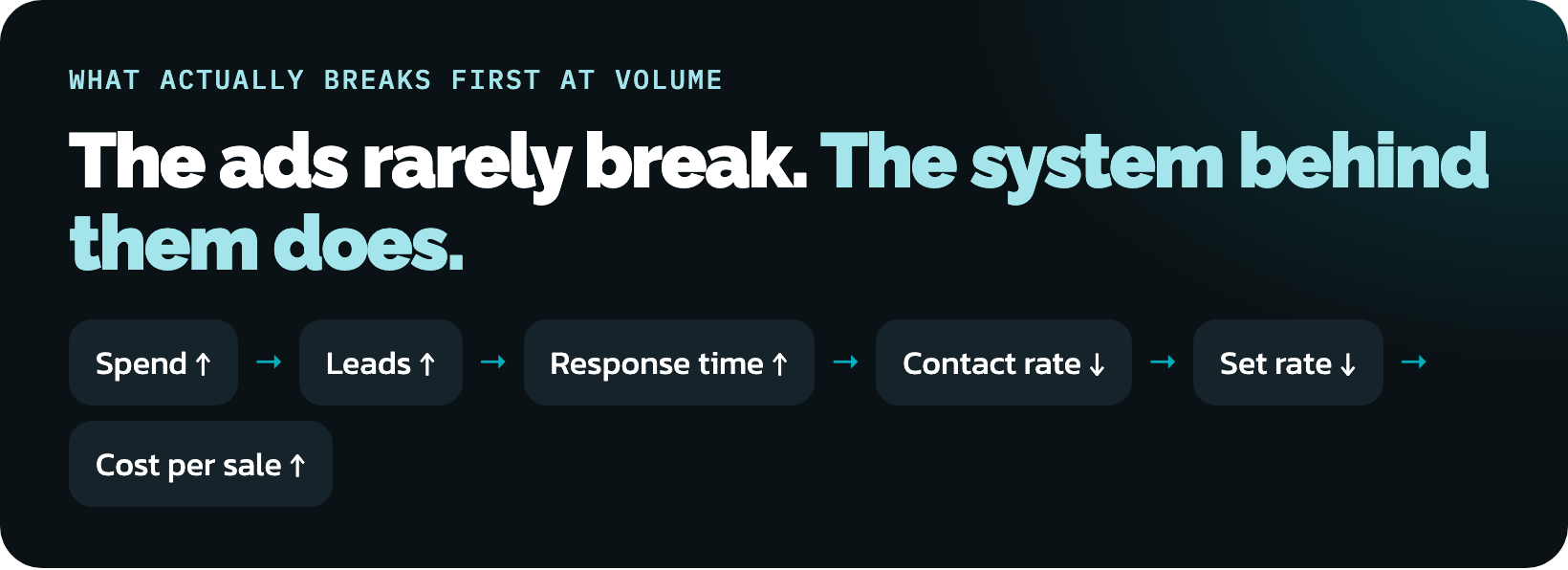
When spend goes up, the first thing to break is usually not the targeting. It’s the time between the form fill and the first real conversation.
A homeowner who asked for a roof quote is warm in the first minutes. The same homeowner reached the next afternoon has already talked to two other companies, or talked themselves out of it. On the dashboard that shows up as “lead quality dropped”. In practice, lead freshness dropped.
Volume makes this worse in three ways:
- Response time stretches. The team that called every lead in five minutes at 20 leads a day can’t do it at 80.
- Follow-up gets skipped. Calls, texts and emails that ran on memory stop running at all.
- Reps start cherry-picking. They work the leads that look easiest and let the rest age.
So before you touch targeting, measure speed to lead by hour and by rep. If it moved when spend moved, the ads didn’t break. Your capacity did. Aquatic Surfaces, a pool resurfacing company, hit exactly this point: once the funnel and CRM follow-up were running, they had so many leads they hired extra staff to handle appointments.
2. Qualify homeowners in the form, not on the phone
At volume, every unqualified lead costs you twice: once in ad spend and again in rep time. The cheapest place to filter is the form.
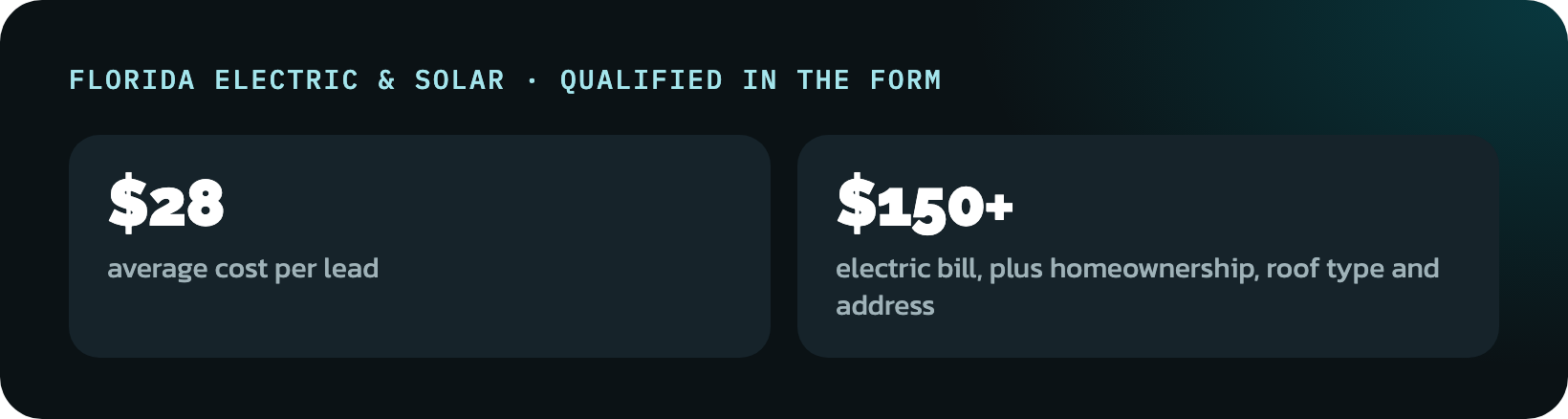
Florida Electric & Solar wanted more leads, better leads and a lower cost per lead in a competitive solar market. We ran Facebook and Instagram lead form ads with qualifying questions built in: homeownership, last electric bill, roof type and address. Facebook autofilled name, email and phone so the sign-up stayed smooth. Leads were screened for homeowners with electric bills over $150, and cost per lead averaged $28.
The trade-off is real. Every question you add lowers volume a little and raises cost per lead. That’s usually the right trade for a high-ticket job, because the leads that drop out are the ones your setters would have burned time on. A few rules we use:
- Ask what disqualifies, not what’s nice to know. Ownership, service area, project type, timeline, and the one number that predicts the sale (like the electric bill for solar).
- Match the form to the job size. Instant forms are fast and cheap but low-commitment. A focused landing page costs more per lead and filters harder. For big tickets, test both and compare cost per sale, not cost per lead.
- Route by answer. Send the strongest answers to your best closers first.
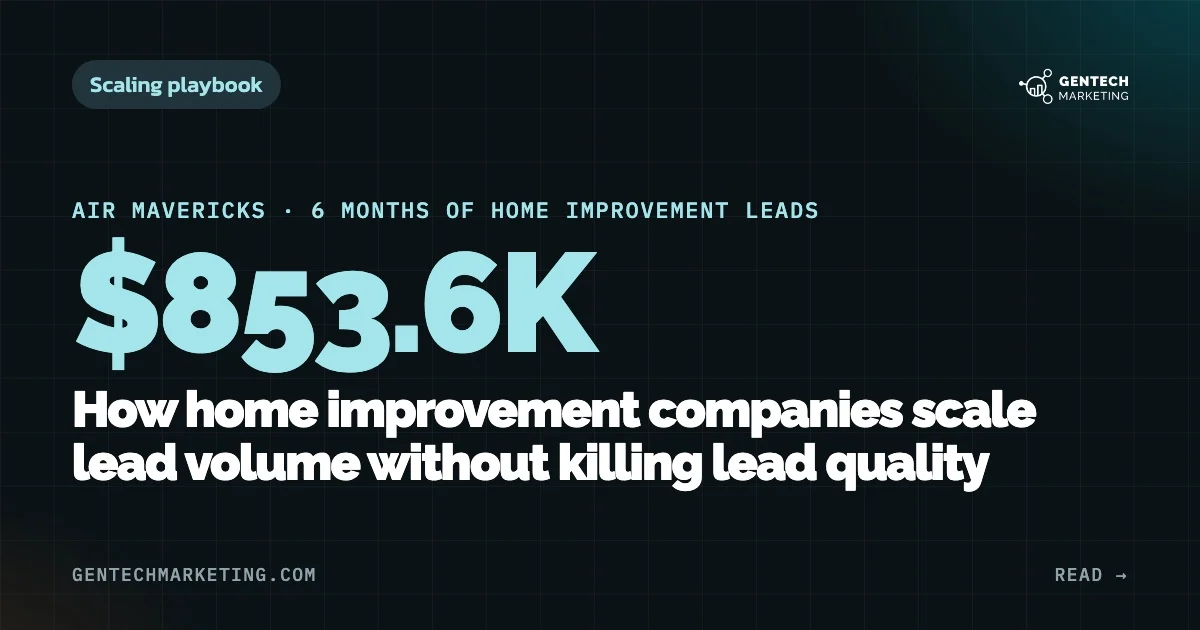
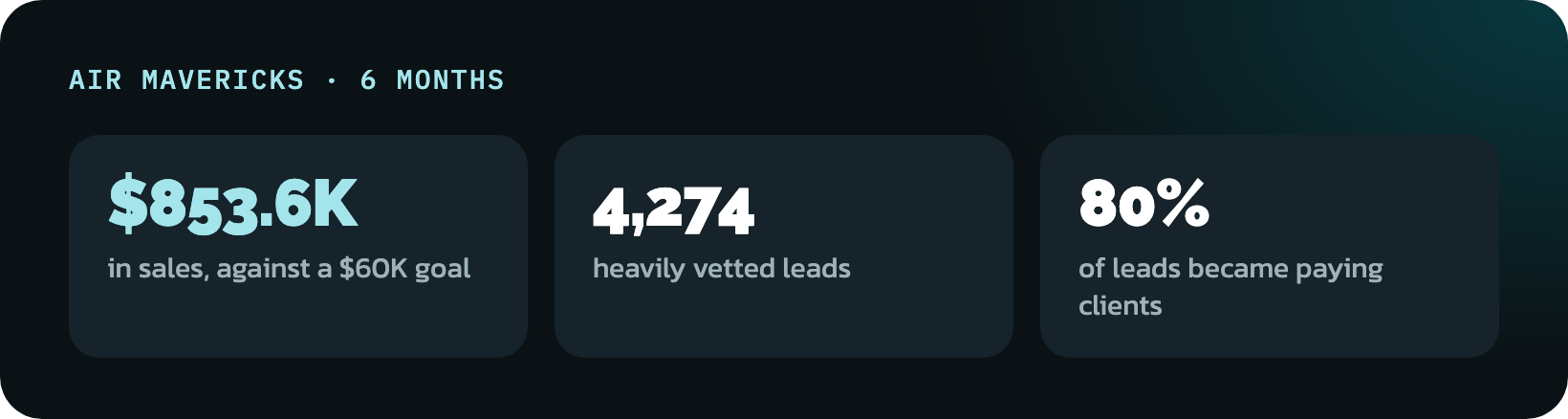
Heavy qualification is also what made volume work for Air Mavericks, an air duct cleaning and restoration company in Florida. We built a strict qualification step into the lead flow so only serious buyers got through, then raised the budget month over month. In 6 months that produced 4,274 vetted leads and $853.6K in sales, against an original goal of $60K, and 80% of the leads became paying clients.
3. Judge campaigns by cost per appointment and cost per sale
Cost per lead is the easiest number to see and the easiest one to be misled by. A cheap lead that never sets an appointment is the most expensive lead you can buy.
Example (round numbers, not a client): Campaign A brings leads at $40. One in 10 sets an appointment, and you close one in four appointments. That’s $400 per appointment and $1,600 per sale. Campaign B brings leads at $100. One in three sets, and you close one in three. That’s $300 per appointment and $900 per sale. Campaign B looks worse in the ad account and is far better for the business.
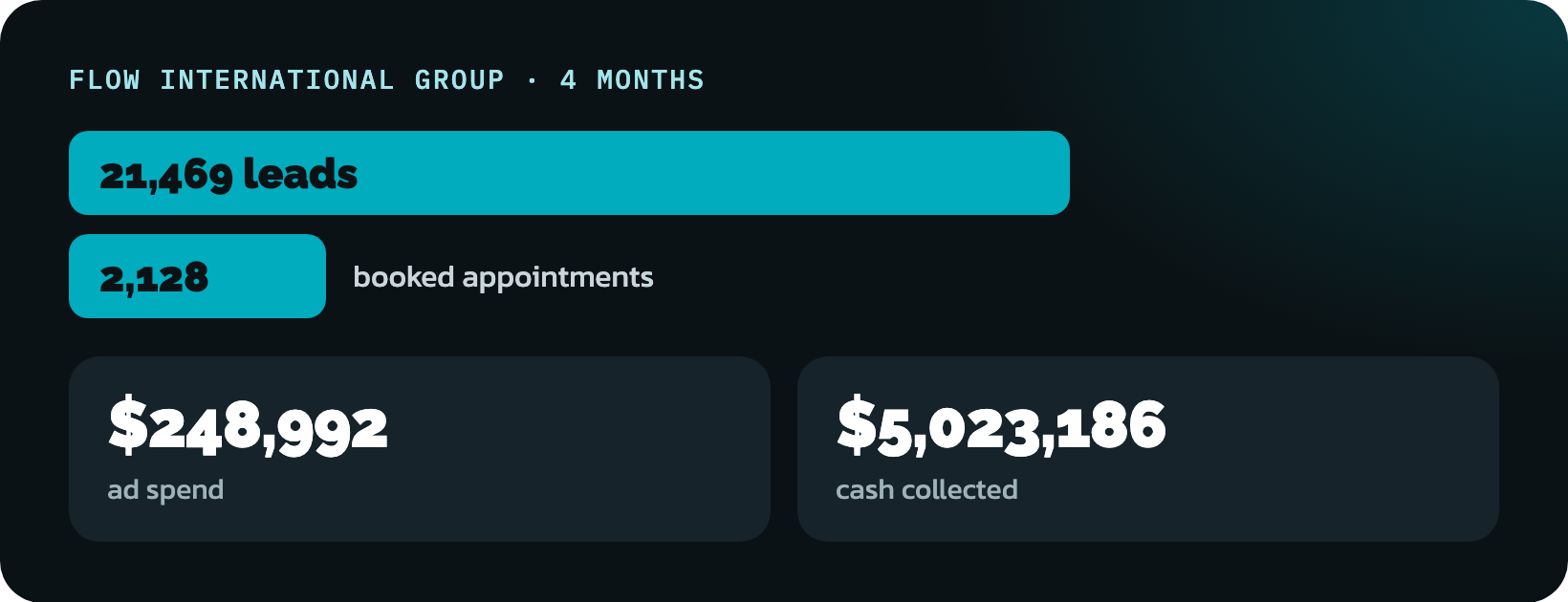
Flow International Group, a call-center sales operation, shows what happens when you optimize for the right number. Their cost per lead had been climbing every time they raised spend, and old, recycled leads were wasting the sales team’s time. We built audiences from CRM data on their highest-value clients, optimized campaigns on closed sales instead of clicks, and ran a weekly creative test. Over four months they generated 21,469 leads and 2,128 booked appointments, and collected $5,023,186 from $248,992 in ad spend. Cost per lead came in at $11.60, above their $10 goal, and was worth it for the lead quality.
This needs closed-loop tracking: every appointment and signed job tied back to its campaign, and that data fed back to the ad platforms. (See our guide on finding revenue bottlenecks and our CRM automation work.)
4. Use creative that pre-sells the job
The ad is your first filter. Generic creative invites generic clicks. Creative that shows the actual job attracts people who want that job.
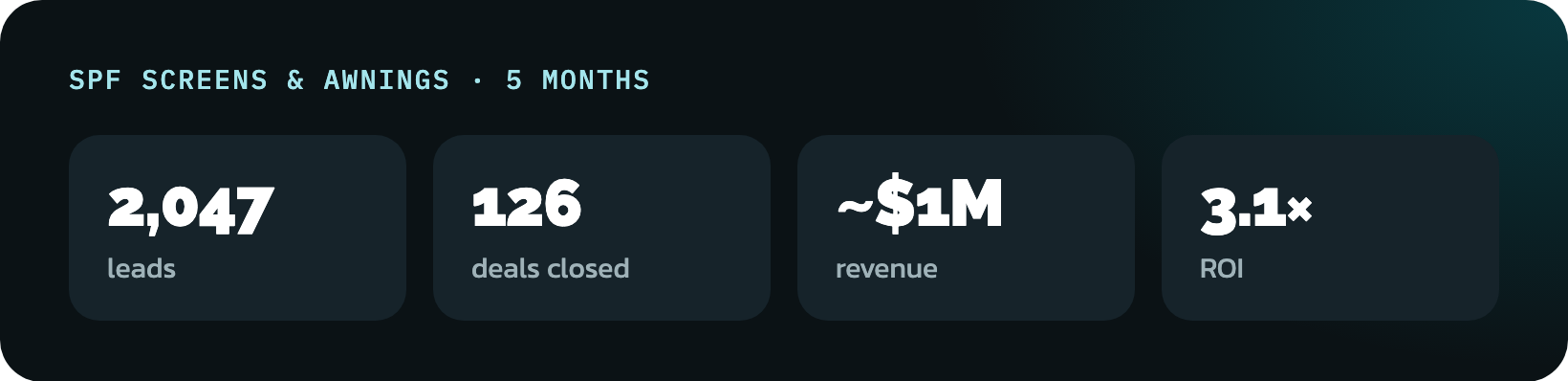
SPF Screens & Awnings sells high-ticket screens and awnings in a competitive Florida market. Lead quality was poor, quality leads cost too much and the flow wasn’t steady. We sent Meta ads to a focused landing page, made before-and-after and TikTok-style videos, built lookalike and interest audiences, and kept optimizing targeting and placements. The result: 2,047 leads in the first five months, 126 deals closed, about $1M in revenue and a 3.1× ROI.
What works for this category:
- Before and after. The finished pool, the new roof, the screened lanai. It shows the outcome and sets price expectations without saying a price.
- The problem moment. A ceiling stain after a storm, a power bill on the counter, a patio nobody uses in July. Homeowners recognize their own house.
- Plain offer, plain next step. What they get, who it’s for, and what happens after they submit.
- Target where buyers can afford the job. For high-ticket work, narrow to service areas and zip codes that match your buyer, not the widest radius.
5. Raise spend in steps, only as fast as quality holds
Doubling ad spend rarely doubles sales. More spend adds weight to every part of the system, and the weakest part breaks first. So scale is a sequence, not a switch.
- Raise budgets in steps, then hold long enough to read set rate and cost per sale before the next step. Jumping a winning campaign from a small budget to a large one overnight often resets its learning.
- Scale sideways as well as up. Duplicate proven ad sets into new audiences and areas instead of only raising one budget.
- Keep most of the budget on proven winners and a smaller share on new creative and audiences, so you have replacements ready when winners fatigue.
- Expand capacity before you expand spend. Automated first reply, systemized follow-up, more setters, or longer calling hours.
Citrus Sod, a Florida sod installer, is a home improvement example of stepping up. We started Facebook ads on a small budget, raised it in week 2 and every week after, and optimized as leads turned into clients: 120+ leads and 17 paying clients in 90 days, at over 6× ROI including our fee.
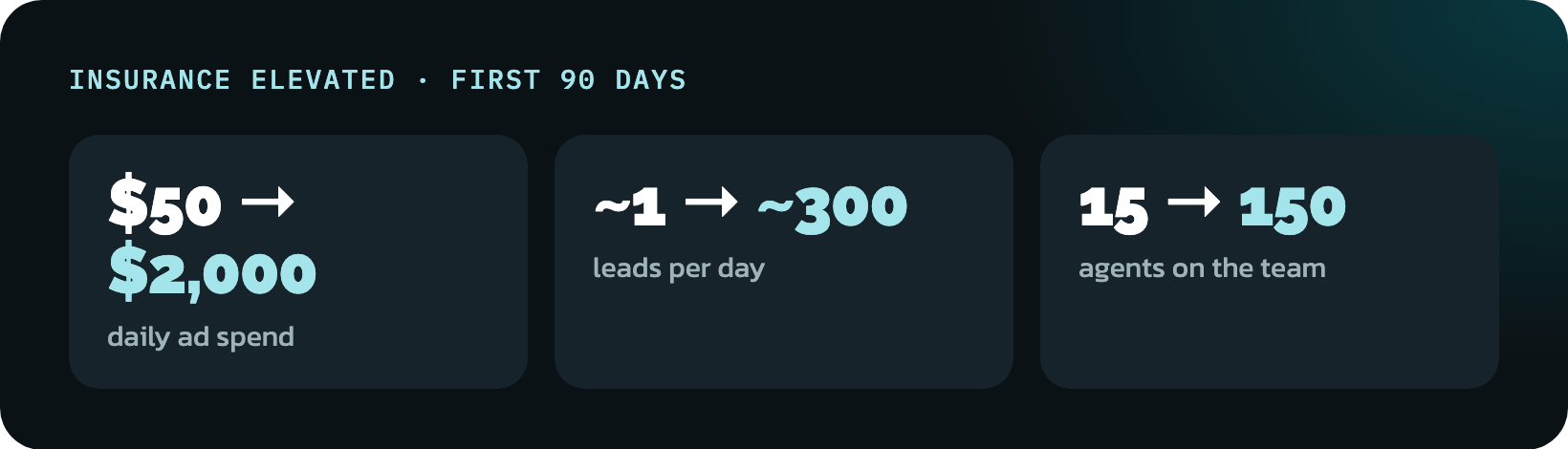
Insurance Elevated, an insurance agency with a sales floor, shows the same approach at a much bigger scale. They were stuck at $50 a day because every push for more volume hurt lead quality. We built a funnel with email and SMS follow-up so every lead was worked fast, then scaled spend step by step, only as fast as lead quality held. Within 90 days they were spending $2,000 a day profitably, at more than 9,200 leads a month (about 300 a day), and their team grew from 15 to 150 agents. (More on setting the ceiling in our budget guide.)
6. Own your lead flow instead of renting shared leads
Shared-lead marketplaces are easy to scale on paper. You buy more, you get more. But the same homeowner is often sold to several companies, so you’re racing competitors to the phone, and your reps feel it in their contact and set rates.
Insurance Elevated’s vendor leads were shared with competitors and rarely closed. Flow’s sales team was losing time on old, recycled leads. Both moved to exclusive leads from their own campaigns, and Flow went further and built a branded lead company of their own.
Owning your lead flow means your own ad accounts, CRM data, creative and landing pages. That’s what lets you optimize toward closed jobs. Shared leads can still fill gaps. They shouldn’t be the engine.
Are you ready to scale?
Check these before the next budget increase:
- You know your speed to lead, by hour and by rep, and it holds at today’s volume.
- Every lead gets an automatic first reply and a set follow-up sequence over several days.
- You know how many leads per day each setter and closer can work well.
- Your form or landing page filters out non-owners, out-of-area leads and wrong project types.
- You can see cost per appointment and cost per sale by campaign, not just cost per lead.
- Closed-job data flows back to the ad platforms.
- You have new creative in testing before current winners fatigue.
- You know what breaks first if volume doubles.
If more than two are “no”, fix those first, then raise spend.
Frequently asked questions
Why does lead quality drop when we increase ad spend?
Usually because the system behind the ads can’t keep up. Response time stretches, follow-up gets skipped and leads go cold before a rep reaches them. Check speed to lead and team capacity before you change targeting.
Should we add qualifying questions if they raise our cost per lead?
For high-ticket jobs, usually yes. Fewer, better leads often lower cost per appointment and cost per sale. Test it and judge by those numbers, not cost per lead.
What metric should a home improvement sales team track for ads?
Cost per appointment and cost per sale, by campaign. Cost per lead is useful for spotting problems early, but it doesn’t tell you what’s making money.
Are shared leads worth buying at scale?
They can fill gaps, but you compete with other companies for the same homeowner. Exclusive leads from your own campaigns give you control over quality and data you can optimize on.
How fast can we scale our ad spend?
As fast as your set rate and cost per sale hold. Raise spend in steps, read the results after each step, and add capacity before the next one.
 Oct 23, 2026The Attribution Modeling Operator Playbook for CMOs
 Oct 22, 2026The attribution modeling playbook in high spend accounts
 Oct 21, 2026Operator Playbook for Attribution Modeling in Competitive Markets